Casino Backlinks: Which Are Safe and Which Get Penalised
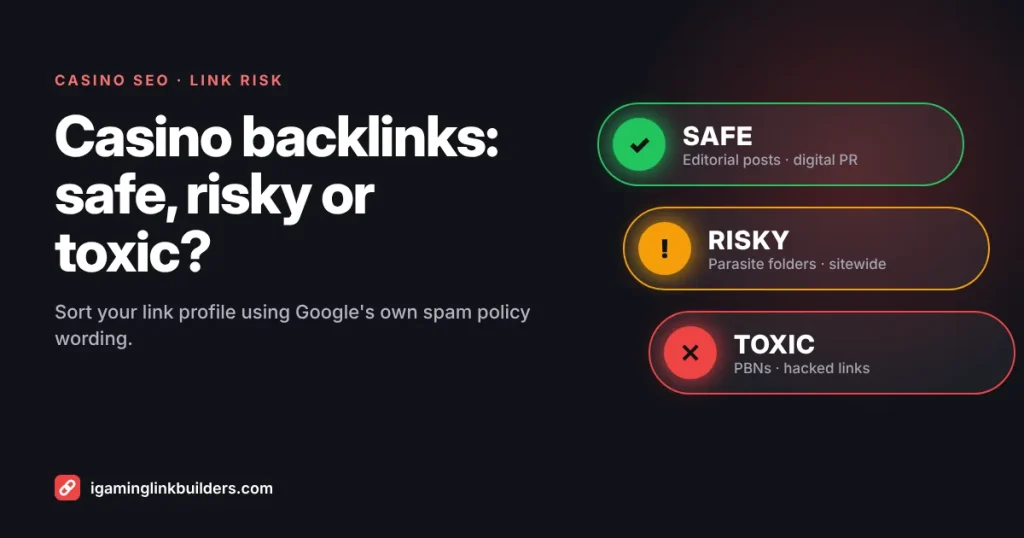
Casino backlinks are still the biggest ranking lever in gambling SEO, and still the fastest way to lose rankings. The difference is rarely the price of the link. It is the pattern the link belongs to. This guide sorts the link types we see in casino profiles into safe, risky and toxic, using Google’s own policy wording, then shows how to audit what you already have. If you want to skip the theory and see how we place vetted links, our buy casino backlinks page lists the publisher tiers and checks.
What Google actually says about link spam
Google’s spam policies for web search define link spam as creating links “to or from a site primarily for the purpose of manipulating search rankings.” The examples it lists read like a description of a typical low-end casino link order.
- Buying or selling links for ranking purposes, including goods, services or free products exchanged for coverage
- Excessive link exchanges and partner pages built only to cross-link
- Using automated programs or services to create links
- Paid text ads or advertorials that pass ranking credit
- Low-quality directory or bookmark links
- Widely distributed links in the footers or templates of various sites
- Low-value content created mainly to manipulate linking signals
The same page says paid links are acceptable when they carry rel=”sponsored” or rel=”nofollow”. Google’s guide to qualifying outbound links says sponsored is the preferred value for paid placements, with nofollow still accepted.
Penalty or just wasted money?
Most bad casino links never trigger a manual action. They simply stop counting. When Google launched its December 2022 link spam update, it said SpamBrain could now detect “both sites buying links, and sites used for the purpose of passing outgoing links,” and that credit from unnatural links would be lost, as Search Engine Land reported.
That is the more common outcome for casino sites. You keep paying for placements that pass nothing, while competitors with cleaner profiles pull ahead. The spam policies page also confirms that violations are caught by automated systems and by human review that “can result in a manual action.”
Site reputation abuse and casino content
Gambling is named directly in Google’s site reputation rules. The spam policies page gives the example of “a medical site hosting a low-quality, third-party advertising page about ‘best casinos’.” That is the classic parasite pattern: a strong, unrelated domain renting a folder to casino affiliates.
Google now files this under its site reputation policy. It applies where third-party content is published on a host “mainly because of that host’s already-established ranking signals.” Hosting third-party content is not a violation by itself; Google looks at presentation, content quality, stated authorship and whether the content appears near-identically elsewhere.
What this means for link buyers: a link from a news site’s sponsored “casino” subfolder is now a liability. The host can be hit, the folder deindexed, and your link goes with it.
Safe, risky and toxic: casino link types compared
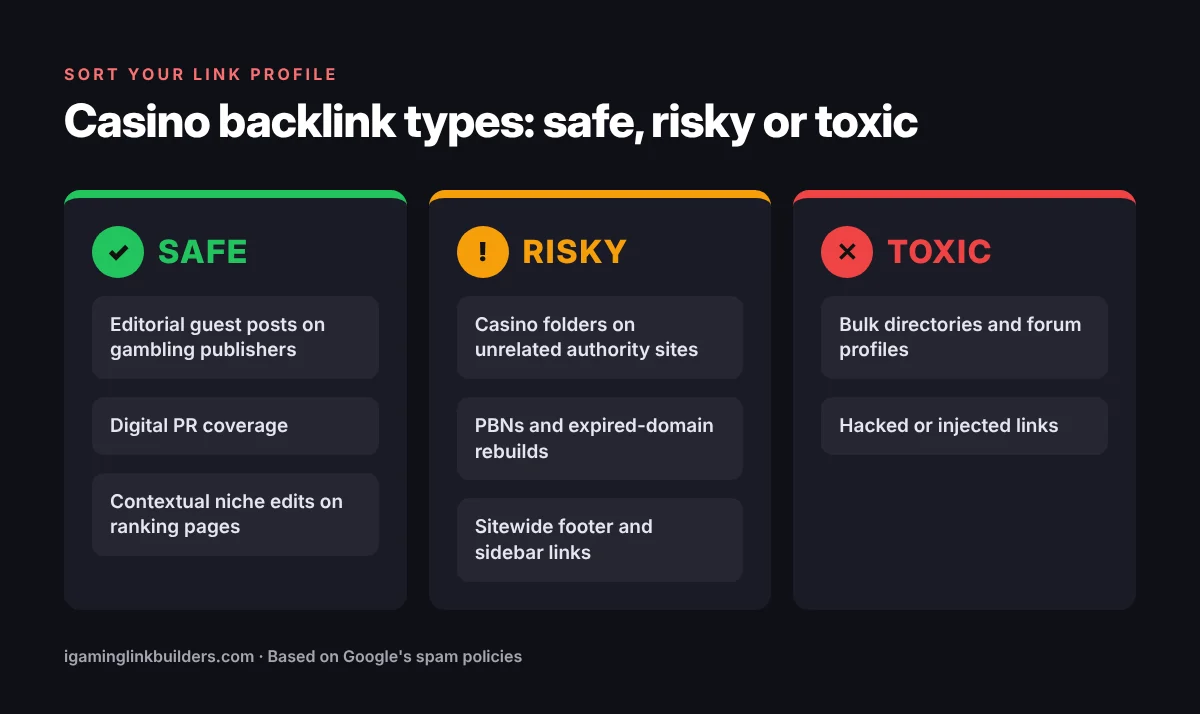
| Link type | Risk | Why |
|---|---|---|
| Editorial guest post on a real gambling or sports publisher | Low | Topical fit, real audience, single contextual link |
| Contextual niche edit on an indexed, ranking page | Low to medium | Safe if the page is relevant and the site has editorial standards |
| Digital PR coverage from news and sports outlets | Low | Earned, often unbranded-anchor, hard to fake |
| Sponsored post marked rel=”sponsored” | Low (no ranking credit) | Compliant, useful for referral traffic and brand |
| Third-party casino folder on an unrelated authority site | High | Fits Google’s site reputation example almost word for word |
| PBN or expired-domain rebuild | High | Built only to pass links; Google also lists casino content on an expired school domain as expired domain abuse |
| Sitewide footer or sidebar links | High | Named in the link spam policy as template links |
| Bulk directory, bookmark or forum-profile links | High | Named in the link spam policy; zero editorial value |
| Hacked or injected links | Toxic | Spam by definition; can drag your domain into a hacked-site cleanup |
Why PBNs keep failing in casino
PBNs sell well in gambling because results can be fast. The problem is the footprint. Shared hosting, recycled themes, thin posts and outbound links to a dozen casinos per site are exactly what SpamBrain was trained to spot. Google’s spam policies also call out expired domain abuse and use casino content on a former elementary school’s site as one of the examples.
Sitewide links look like a bargain
A sitewide link on a DR 60 site is often sold as “hundreds of links for one price.” Google sees one domain repeating the same template link across every page. That is the “widely distributed links in the footers or templates” example from the policy. One contextual link on a relevant page beats it every time.
Paid-link disclosure in gambling
Two separate rulebooks apply when you pay for a casino placement. Google cares whether the link passes ranking credit without qualification. Advertising regulators care whether the content is an ad.
In the UK, the ASA notes that gambling content linked to an operator’s services can be an ad under the CAP Code, and that independent editorial content is excluded (“The odds are… it’s an ad“). The Gambling Commission also expects licensees to “take responsibility for third parties” they contract with, under SR code 1.1.2, as set out in its guidance on affiliates and third parties.
In practice, that means every placement should be suitable for an 18+ audience, avoid content with strong appeal to under-18s, and target only markets where the brand is licensed. A placement that breaks those rules is a compliance problem before it is an SEO problem.
How to audit an existing casino link profile
Run this audit before you buy anything new. Older casino domains often carry inherited risk from past vendors you no longer remember using.
- Export everything. Pull referring domains from Google Search Console plus one third-party tool, and merge them. Search Console alone misses links; tools alone miss what Google actually sees.
- Tag by acquisition source. Mark each domain as earned, bought, partner, affiliate or unknown. Unknown links in a casino profile are often old vendor placements.
- Check for template patterns. Filter for domains sending hundreds of links. Those are sitewide or footer links and should be removed or nofollowed.
- Check for network footprints. Look for clusters with the same theme, registrar pattern, thin posts and casino-heavy outbound links. Treat these as a PBN until proven otherwise.
- Check for parasite folders. Flag links from casino sections on unrelated authority sites. These are the site reputation risk described above.
- Check the anchor mix. If exact-match terms like “best online casino UK” dominate, your anchors look bought. Rebalance future links toward branded and URL anchors.
- Check that links are indexed and live. A link on a deindexed page passes nothing. Note dead and deindexed placements so you stop paying for similar ones.
- Decide: remove, nofollow, disavow or keep. Ask for removal first, then disavow what remains if the risk is serious.
When disavow is the right call
Google’s disavow documentation says to use the tool only when you have a considerable number of spammy, artificial or low-quality links, and they have caused or are likely to cause a manual action. Most sites don’t need it. For casino domains with a history of PBN or sitewide buying, though, that second condition is often met, and a targeted domain-level disavow is sensible.
What a safe casino link order looks like
The safest links share a few traits you can check before paying. This is the 9-point check every publisher passes before we put it in front of a client.
- Topical fit with casino, sports or gambling-adjacent content
- Real and stable organic traffic, not a sudden spike
- Traffic from the client’s target markets
- Real keyword rankings, not just a high DR
- Sane outbound links, not twenty casinos per post
- Evidence of editorial oversight
- No site reputation abuse pattern
- Not already in the client’s link profile
- Indexation confirmed after the placement goes live
We also refuse PBNs, expired-domain rebuilds, hacked placements, sitewide or footer links and automated outreach. Anchors stay mostly branded or URL-based, with exact-match kept for the strongest placements only. You can see how this fits into a full campaign on our casino link building page, and our gambling niche edits service applies the same checks to existing articles.
On cost, DR 30+ gambling placements run $350 a link and DR 50+ placements $500, with 800 to 1,200 words written per placement. Our iGaming link building price guide explains why cheaper links in this niche usually come from the risky rows of the table above.
FAQ
Are paid casino backlinks against Google’s rules?
Buying links that pass ranking credit is listed as link spam in Google’s policies. Paid links marked rel=”sponsored” or rel=”nofollow” are allowed. With editorial placements on real publishers, the risk sits in the pattern and the publisher you choose, so vet both before you pay.
Do PBN links still work for casino sites?
They can move rankings for a while, which is why they are still sold. Google says SpamBrain detects both link buyers and sites built to pass outgoing links, and that credit from unnatural links is lost. When a network is caught, the rankings it built disappear with it.
How often should I audit my casino link profile?
Audit fully before any new campaign, then review new and lost links monthly. We re-check our own placements at 14 days, 90 days and quarterly after that, and replace any lost or deindexed link free for 12 months.
Should I disavow every low-DR link?
No. Low DR is not the same as spam. Google advises disavowing only when there is a considerable number of spammy or artificial links that could lead to a manual action. Focus on networks, sitewide links and parasite folders.
Get a vetted shortlist
Our iGaming link building agency works only in gambling, so every publisher on your list already covers it. If you want casino backlinks that pass a policy review as well as a metrics check, start with our casino backlink packages. We send a publisher shortlist for approval within two working days, and nothing is pitched until you sign off. For multi-market or custom plans, contact us and we will quote within two working days.