How to Find Gambling Sites That Accept Guest Posts
Lists of gambling sites that accept guest posts go stale fast. Sites change owners, raise prices, get deindexed or start selling to anyone, and a list from last year can point you straight at a link farm. This guide gives you the method instead: how to find candidates, how to vet them, what to reject and how to pitch. If you would rather skip the sourcing, our iGaming guest posting service does this work for you.
Why most “write for us” lists fail you
The pages ranking for this topic tend to be lists of domains or a few search strings with no way to judge what they return. Neither tells you whether a site is worth a link.
Publishing a list also creates its own problem. Once a domain appears on a public list, it gets hundreds of pitches, and many owners respond by accepting everything. That is how a decent blog turns into a link farm within a year.
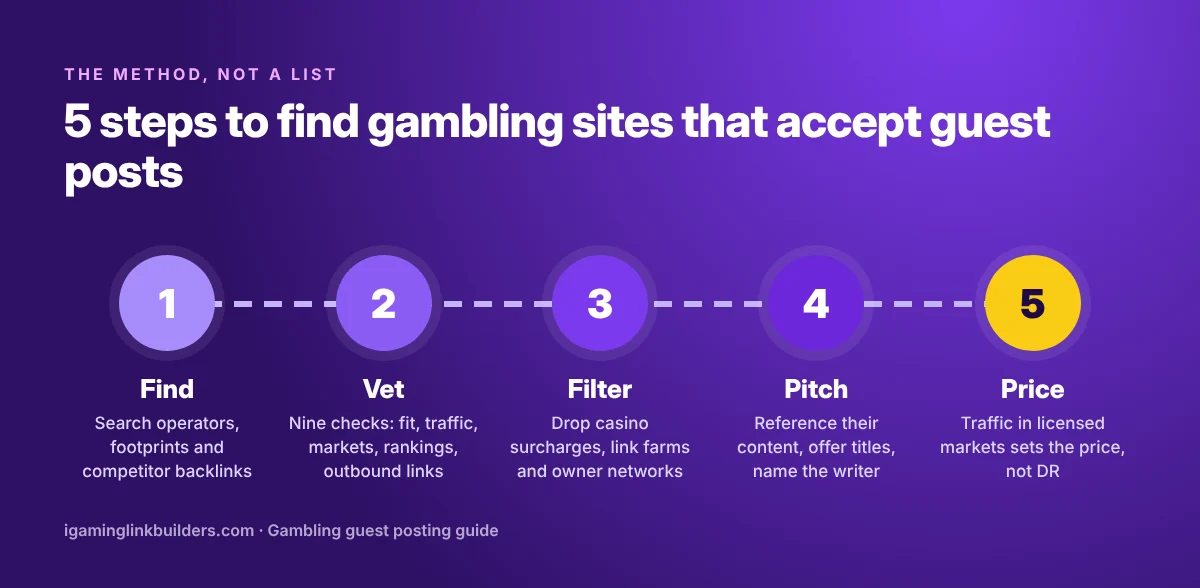
Step 1: Find candidates with search operators
Start broad, then narrow by market and vertical. Swap “casino” for “betting”, “poker”, “slots”, “bingo” or “igaming” to cover each vertical.
- casino “write for us”
- betting “guest post guidelines”
- intitle:”write for us” gambling
- inurl:write-for-us casino
- poker “submit a guest post”
- igaming “contribute” OR “contributor guidelines”
- “sponsored post” sports betting
- “guest post by” casino
- site:.co.uk “write for us” betting
- site:.ca “guest post” casino
Footprints that find better sites
The obvious operators return the sites everyone already pitches. These variations surface publishers that are less saturated.
- Search for author bio phrases such as “this article was written by” alongside a gambling term. Sites that publish bylined contributors leave this footprint.
- Search for topical gaps rather than “write for us”. A query like “responsible gambling tools” blog finds sites that write about gambling but may never have advertised guest posts.
- Add a market term, such as “Ontario” or “New Jersey”, to narrow results to sites covering licensed markets you care about.
Use competitor backlinks
Pull the referring domains of three to five competitors in a link research tool. Filter for links from blog or news paths and look for author pages or “guest” in the URL.
A site that already linked to a competitor with an editorial article is a proven publisher. Check it the same way you would check a cold result.
Step 2: Vet every site before you pitch
Finding a site takes seconds. Vetting it properly takes 10 to 15 minutes, and that is where most of the value is. Below is the checklist we use, built around the same 9 points every publisher must pass before reaching a client shortlist.
| Check | What to look for | Fail signal |
|---|---|---|
| Topical fit | Regular gambling or sports content written for players | Gambling posts mixed with CBD, essays, loans |
| Real traffic | Organic traffic stable or growing over 12 months | Sudden spike, then a cliff |
| Market match | Traffic from the countries you are licensed in | Traffic mainly from markets you cannot serve |
| Real rankings | Ranks for informational and commercial terms | Ranks only for its own brand name |
| Outbound links | A few editorial links per post | Many casino links in every article |
| Editorial oversight | Named editors, author pages, consistent style | No authors, anonymous “admin” posts |
| Site reputation pattern | Gambling content fits the site’s main topic | Casino pages bolted onto an unrelated site |
| Not already linking to you | New referring domain | Already in your backlink profile |
| Indexation | Recent posts indexed | Recent posts missing from the index |
The site reputation check
This deserves its own step. Google’s spam policies use “a medical site hosting a low-quality, third-party advertising page about best casinos” as an example of site reputation abuse.
A news or lifestyle site with a sudden “casino” section is the classic case.
Check who the site already promotes
Look at which operators a candidate already links to. The UKGC advises checking that licence details, “including activities and website domain names”, match the public register. A site linking to unlicensed brands in a regulated market is a poor neighbour for a licensed operator.
Step 3: Know the red flags
Some problems show up only when you contact the site or read its guidelines closely.
- A price list with “casino” as a surcharge category on a general site. The site accepts gambling links for money, not because it covers gambling.
- “Link insertion in any post” offered at the same price. The owner is selling inventory, not editorial space.
- No limit on links per post. Expect your article to share space with unrelated commercial links.
- Guaranteed dofollow, permanent, no review. Real editors review content, and nobody can guarantee permanence.
- Same owner email across dozens of domains. A common sign of a network built to sell links.
- Spun or AI-filler posts in the archive. If their content is thin, yours will sit among it.
Google’s 2017 warning on large-scale article campaigns still describes the pattern to avoid. As Search Engine Land reported, the warning signs included “stuffing keyword-rich links to your site in your articles” and “using or hiring article writers that aren’t knowledgeable about the topics they’re writing on”.
Step 4: Pitch like a contributor, not a buyer
Gambling editors receive a lot of identical pitches. The ones that get replies show they read the site and offer something its audience needs.
- Reference a specific recent article and say what your piece adds to it.
- Offer two or three titles that fit the site’s existing categories.
- Say who will write it and why they know the topic, such as a former trader, a payments specialist or a compliance lead.
- State your link request up front: one link, in context, to a relevant deep page.
- Ask about their sponsored content policy rather than assuming.
Keep the content compliant. Write for adults in licensed markets, avoid promising wins and include responsible gambling context where it fits.
Step 5: Set realistic pricing expectations
Most gambling publishers charge for guest posts. Google treats “exchanging money for links, or posts that contain links” as link spam in its spam policies, unless those links are qualified with rel=”sponsored” or nofollow as described in its guide to qualifying outbound links. Factor that risk into how many paid placements you build and how you pace them.
We do not publish other vendors’ prices, because they change and vary by deal. What drives the price of a gambling guest post is consistent:
- Organic traffic in tier-one licensed markets
- Topical focus on gambling rather than general content
- Whether the site limits how many gambling posts it accepts
- Content length and who writes it
- Turnaround and replacement terms
For reference, our own published rates are $350 per link on DR 30+ gambling publishers and $500 on DR 50+, including 800 to 1,200 words written per placement. Packages start at $3,500 for DR 30+ and $5,000 for DR 50+. The full breakdown is in our iGaming link building price guide.
When to do it yourself and when to outsource
DIY makes sense if you need a handful of links a quarter and have someone who can vet sites properly. It stops making sense when you need volume across several markets, or when vetting time costs more than the links.
Agencies reselling gambling links to their own clients can use our white label link building, which follows the same vetting process.
FAQ
Is it safe to use a public list of gambling sites that accept guest posts?
Use lists only as a starting point. Run every site through the vetting checklist, because public lists attract heavy pitching and quality drops fast. Always verify current terms with the publisher directly.
How many gambling guest posts should I build per month?
There is no safe fixed number. Match your pace to your current profile and to what competitors in your market have built, and mix guest posts with other link types.
Should gambling guest post links be nofollow or sponsored?
Google’s guidance says paid links should be qualified with rel=”sponsored” or nofollow. Many publishers do not apply this, which is part of the risk buyers accept. Weigh it when deciding volume and anchors.
What anchor text should I use in a gambling guest post?
Mostly branded or URL anchors. Keep exact-match anchors for the strongest, most relevant placements, and link to deep pages rather than your homepage by default.
iGaming Link Builders runs campaigns like this for operators and affiliates every month. If you want vetted gambling publishers without the sourcing work, we send a shortlist for your approval within two working days and pitch nothing until you sign off. See our iGaming guest posting service or contact us with your markets and targets.