Sportsbook Backlinks Strategy: Timing, Markets, Anchors
A sportsbook backlinks strategy has to answer three questions casino link plans can mostly ignore. When do the links need to be live, relative to the sporting calendar? Which regulated market is each page for? And who is building them, an operator or an affiliate? Get those wrong and you pay for links that land after the traffic peak, on pages a regulator would not want promoted in that market. This guide covers all three, with a page-to-anchor map you can copy. If you want it run for you, our sports betting links service is built on this approach.
Operators vs betting affiliates: different link jobs
Operators and affiliates compete for the same SERPs but need different link profiles. An operator is building a brand that people search for by name. An affiliate is building topical authority across many brands, markets and events.
| Sportsbook operator | Betting affiliate | |
|---|---|---|
| Main ranking targets | Brand terms, “[brand] promo code”, state or province pages | “Best betting sites”, odds and picks, event hubs, reviews |
| Strongest link types | Digital PR, sports news coverage, sponsorship mentions | Guest posts on sports and betting publishers, niche edits, data assets |
| Anchor profile | Heavily branded | Branded plus partial match, limited exact match |
| Main compliance owner | The operator, directly | The operator it promotes, plus its own obligations |
| Biggest risk | Bonus-led placements in restricted markets | Over-optimised anchors to money pages |
Operators carry responsibility for affiliates too. The UK Gambling Commission tells licensees they must “take responsibility for third parties with whom you contract,” under SR code 1.1.2, in its guidance on affiliates and third parties. That is why operators should vet the links their affiliates build, and why affiliates with clean link profiles are easier to sign.
Operator playbook
Operators get the best return from coverage that mentions the brand naturally: partnership announcements, data stories, market launches and expert commentary on odds movements. Our iGaming digital PR work focuses on that kind of earned coverage. Guest posts fill the gaps on state and province pages.
Affiliate playbook
Affiliates need depth around events and markets. A strong affiliate profile has links into evergreen hubs (NFL betting, Premier League betting), market pages (betting sites in Ohio, UK betting sites) and a few linkable data assets. Our affiliate link building plans follow this structure.
Time links to the event calendar
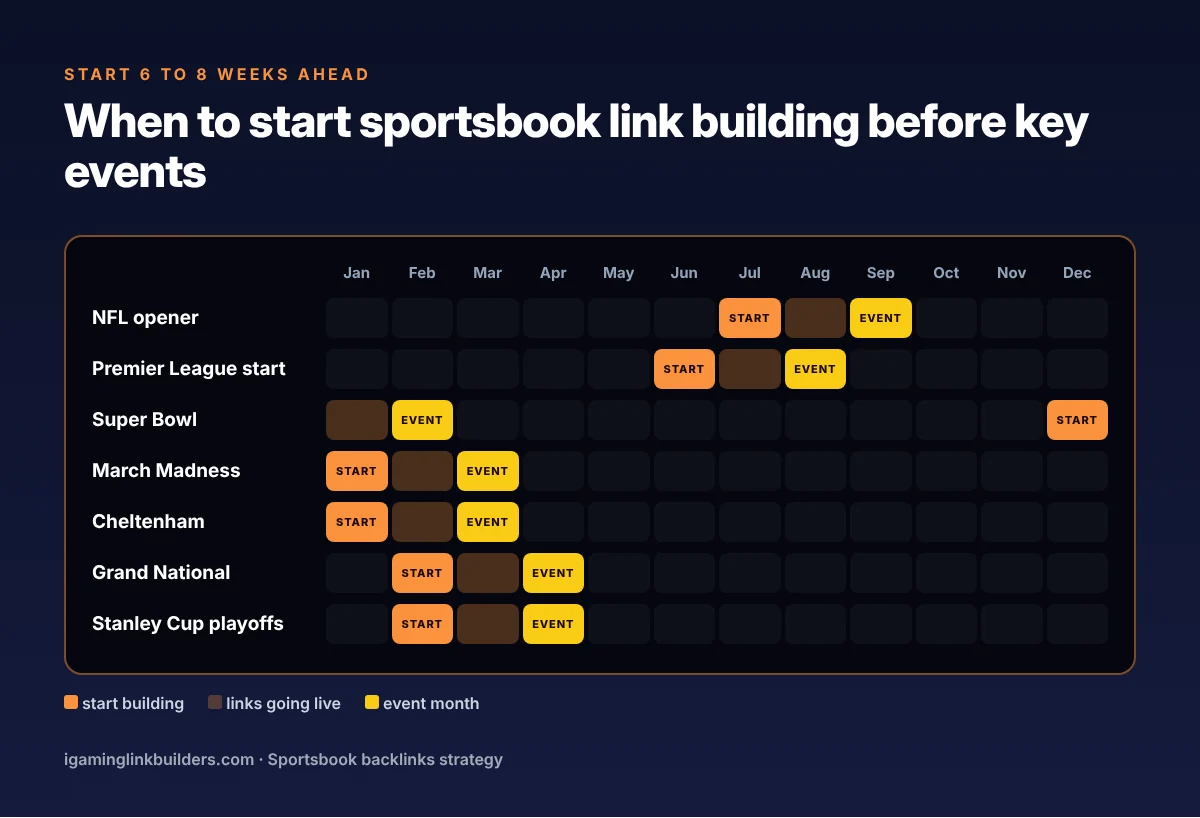
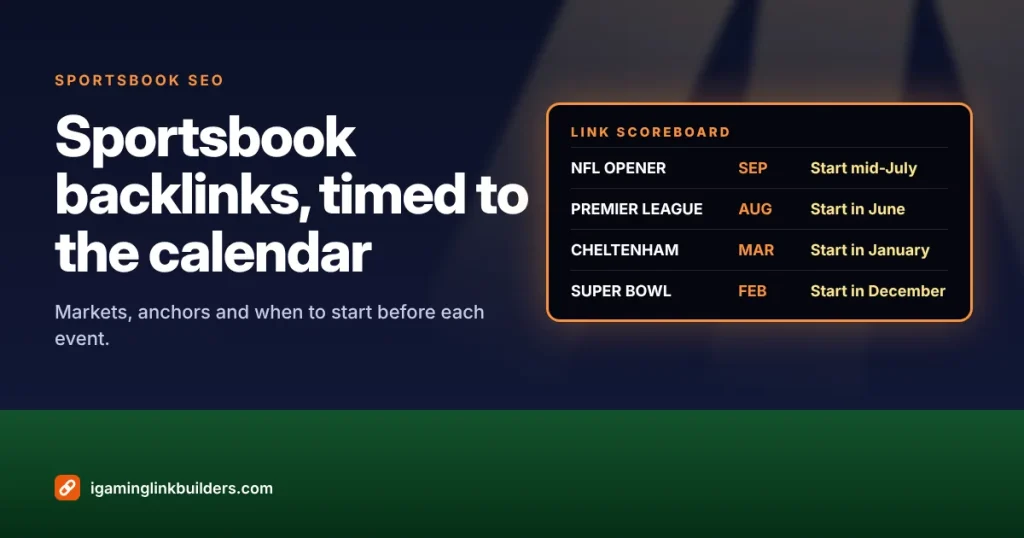
Sports betting search demand is seasonal and spiky. Links take time to be published, crawled and counted, so the order has to go in well before the event. Our placements go live 10 to 14 days after approval, and the shortlist itself takes up to two working days. Add indexing time and you need to start roughly six to eight weeks ahead.
| Event window | Main market | Pages to push | Start link building |
|---|---|---|---|
| NFL season opener (September) | US states | NFL betting hub, state pages, team pages | Mid-July |
| Premier League start (August) | UK | Premier League betting hub, top scorer markets | June |
| March Madness (March) | US states | College basketball hub, bracket content | January |
| Cheltenham Festival (March) | UK and Ireland | Horse racing hub, Cheltenham betting guide | January |
| Grand National (April) | UK | Grand National betting guide | February |
| Stanley Cup playoffs (April to June) | Ontario and US states | NHL betting hub, Ontario sportsbook page | February |
| Super Bowl (February) | US states | Super Bowl betting guide, props page | December |
Two rules make this work. First, link the evergreen hub, not a page with the year in the URL, so links keep their value next season. Second, keep building through the off-season at a lower pace. A profile that only grows in the six weeks before the Super Bowl looks bought.
Regulated market differences
Link strategy for sportsbooks is market by market. A placement that is fine for a UK page can be a problem for an Ontario one.
US states
Sports betting is legal in 39 states plus Washington, DC, and 31 of those states plus DC have statewide online markets, according to Track360’s July 2026 state tracker. The rest are retail-only. Rules move often, so check the state regulator before launching a page.
For links, this means:
- Build state pages only for states where your brand, or the brands you promote, are licensed
- Prefer publishers with real traffic in that state, such as local sports sites and regional news
- Use state-specific anchors sparingly (“Ohio sportsbooks”, “betting in Ohio”) and point them at the matching state page
- Avoid linking state pages for retail-only or unregulated states with commercial anchors
UK
The UK is a single national market, so links can target national hubs. The constraint is content, not geography. The CAP Code’s “strong appeal” test, in force from 1 October 2022, bars gambling ads likely to be of strong appeal to under-18s, including top-flight footballers with a large under-18 following, as iGaming Business reported.
The ASA also notes that content tied to an operator’s services can count as an ad, while independent editorial content is excluded (“The odds are… it’s an ad“). Placements written around a star player’s image, or published on sites with a young audience, are the ones to avoid.
Ontario
Ontario is the strictest of the three for bonus-led content. The AGCO’s Standard 2.05 allows bonuses and inducements to be offered on the operator’s own site, or by direct marketing after a player has consented. It strictly prohibits broad public advertising of them, as its 2022 penalty against Unibet ON shows.
The AGCO also banned athletes from Ontario igaming advertising from February 28, 2024. For Ontario links, keep placements editorial, skip “welcome bonus” anchors and offer-led articles, and check every brief with your compliance team.
| Market | Safe anchor examples | Avoid |
|---|---|---|
| US states | Brand name, “[state] sportsbooks”, URL | State anchors pointing at unregulated-state pages |
| UK | Brand name, “Premier League betting”, URL | Content built around players popular with under-18s |
| Ontario | Brand name, “Ontario sportsbook”, URL | “Bonus”, “free bet”, “welcome offer” anchors and offer-led articles |
Anchor and target page mapping
Most sportsbook link profiles go wrong at the mapping stage. Links get sent wherever the anchor sounds good, and two pages end up competing for the same term. Map each anchor family to one page before outreach starts.
| Target page | Primary anchor family | Supporting anchors | Notes |
|---|---|---|---|
| Homepage | Brand name, URL | “sportsbook”, “online betting site” | Takes the largest share of links |
| State or province page | “[market] sportsbook”, “betting in [market]” | Brand + market | One page per licensed market |
| Sport hub (NFL, Premier League) | “[sport] betting” | “[sport] odds”, “bet on [sport]” | Evergreen URL, no year |
| Event guide (Super Bowl, Cheltenham) | “[event] betting” | “[event] odds”, “[event] tips” where allowed | Linked from the sport hub |
| Review (affiliates) | “[brand] review” | Brand name, URL | Never exact-match “best sportsbook” |
| Best betting sites page (affiliates) | Partial match, topic phrases | Exact match on strongest placements only | The most sensitive page in the profile |
Google’s link best practices describe good anchor text as “descriptive, reasonably concise, and relevant,” and warn against cramming in every related keyword. That matches what works in practice: our default is a majority of branded or URL anchors, with exact match kept for the strongest placements.
Publisher vetting for sports betting links
Sports publishers vary more than casino ones. A large sports blog can have huge traffic in the wrong country, or sell sportsbook folders to anyone. Google’s spam policies cover both risks: link spam includes buying links that pass ranking credit, and the site reputation policy covers third-party content hosted to exploit a site’s ranking signals.
Before any placement, we check:
- Real, stable traffic from the target state, province or country
- Topical fit with sports or betting content
- Real keyword rankings, not just a high DR
- Sane outbound links and visible editorial oversight
- No sportsbook or casino folders rented to third parties
- Indexation confirmed after the link goes live
Every link is re-checked at 14 days, 90 days and then quarterly, with free replacement for 12 months. For the wider SEO picture, see our iGaming SEO guide.
FAQ
When should a sportsbook start building links for the NFL season?
Start about six to eight weeks before the opener, so mid-July for a September kick-off. That leaves time for approval, publication and indexing. Keep a lower monthly pace through the off-season so the profile does not spike.
Can I use bonus anchors for Ontario sportsbook links?
Avoid them. The AGCO restricts bonuses and inducements to the operator’s own site or consented direct marketing, and prohibits broad public advertising of them. Use branded and market anchors, and keep the content editorial.
Should affiliates link to state pages in states without online betting?
Not with commercial anchors. Build state pages for markets with legal online wagering and licensed brands. Informational pages on pending legislation can earn links naturally, but keep those anchors descriptive.
Do operators and affiliates need different publishers?
Often, yes. Operators benefit most from news and sports coverage that mentions the brand. Affiliates need sports and betting publishers that link to hubs, reviews and market pages.
Build your sportsbook link plan
As a specialist iGaming link building agency, we only build links in the gambling industry. If you want links mapped to the sporting calendar and the markets you are licensed in, see our sportsbook link building service. DR 30+ placements are $350 a link and DR 50+ placements $500, with a vetted shortlist sent within two working days. For a multi-market plan, contact us.