iGaming Link Building Strategies for 2026

iGaming link building in 2026 is the work of earning relevant third-party links and mentions for an operator or affiliate while controlling three risks: search spam, publisher quality and gambling-marketing compliance.
The short version is simple. Build assets that credible publishers have a reason to cite. Pitch people whose audiences overlap with yours. Treat paid placements as advertising, not earned editorial coverage. Check every live page for accuracy, disclosure and link attributes. Measure qualified referring domains, referral value and target-page performance instead of counting links alone.
Google still says links help it discover pages and understand relevance. It also says that links created mainly to manipulate rankings are link spam. Those two facts define the job: earn citations because the page, data or expert improves the publisher’s work, not because a vendor can place a keyword-rich anchor at scale. See Google’s link best practices and spam policies.
Evidence convention: Factual claims in this guide link to a source opened during research. Unlinked recommendations, scorecards, examples and prioritisation rules are the author’s editorial analysis. They are operating frameworks, not statements from Google or a regulator. Regulatory examples are not legal advice; confirm the rules in every market you target.
The decision in one table
| If you need to… | Start with… | Do not start with… |
|---|---|---|
| Build authority for a new market | Local data, licensed-market explainers, trade media and relevant partnerships | A bulk package of unrelated “high-DA” guest posts |
| Move a commercial category page | A useful supporting asset, internal links and a small set of closely relevant editorial citations | Repeating the commercial keyword in every external anchor |
| Earn mainstream coverage | Original data, expert commentary and a clear news angle | A press release written only to carry a link |
| Strengthen an affiliate site | Transparent testing methods, review evidence and original comparison data | Rewritten operator copy or thin “best casino” pages |
| Recover from risky historical links | Evidence collection, removals, Search Console review and specialist assessment | Automatically disavowing every low-metric domain |
| Select an agency | Sample placements, process evidence, contract controls and live reporting | Guarantees based on link volume, DA/DR or ranking dates |
What makes iGaming link building different?
The mechanics are not unique. You still research audiences, create useful material, pitch publishers and measure outcomes. The operating constraints are different.
First, many prospective publishers will not accept gambling content, a constraint described by specialist agencies in the ranking set, including igaming linkbuilders. That reduces the relevant inventory and makes poor-quality networks look attractive. Second, a link placement may also be a gambling marketing communication, an affiliate endorsement or a paid advertisement. Third, the operator can remain responsible for work carried out by contracted affiliates and other third parties in some regulated markets.
For example, the UK Gambling Commission’s LCCP says licensees are responsible for contracted third parties involved in licensed activities and must be able to terminate relationships when a third party breaches relevant advertising rules. The ASA also states that UK gambling marketing includes work by affiliates acting on an advertiser’s behalf and must protect children, young people and vulnerable people. See UKGC LCCP 1.1.2 and ASA guidance on gambling advertising.
In the United States, the FTC says a material connection between an endorser and marketer should be disclosed clearly and conspicuously. Its affiliate guidance says the disclosure should be close enough to the recommendation and link for the reader to understand the connection. See the FTC’s Endorsement Guides Q&A.
That does not mean one UK or US rule applies worldwide. It means compliance review belongs inside prospecting, briefing and quality assurance, not at the end of the campaign.
Set four gates before you acquire a link
1. Market gate
Document the country or state the destination page targets, the licence under which it operates, the permitted audience and the promotion restrictions that apply. A globally accessible publisher does not remove the need to assess the audience that can see the placement.
Your campaign brief should state:
- allowed and excluded markets;
- minimum age and audience restrictions;
- claims, bonuses and calls to action that require approval;
- responsible gambling wording;
- whether the publisher may mention the brand, product or offer;
- the legal or compliance owner who can approve exceptions.
2. Search-policy gate
Ask why the link will exist. If the honest answer is “because we paid for ranking credit,” stop or require the publisher to qualify it.
Google lists paid links intended to influence rankings, excessive exchanges, automated link creation, low-quality directories, optimised links in paid advertorials and keyword-rich forum comments as examples of link spam. It permits advertising and sponsorship links when they are marked with rel="sponsored" or rel="nofollow". See Google’s link-spam policy and outbound-link qualification guidance.
3. Editorial gate
Reject a placement if the page would not make sense without the link. A valid citation should support a fact, give the reader a useful next step, identify a source or provide access to a tool.
Require the publisher to retain control of its editorial decision. Do not force a followed link, an exact-match anchor or a positive verdict through a contract. Google specifically includes required links that do not allow the third party to qualify the link among its link-spam examples.
4. Measurement gate
Define the target page, baseline, business purpose and review date before outreach starts. “Build 30 links” is a production target, not an outcome.
A useful campaign record includes:
- target page and query cluster;
- current clicks, impressions and average position;
- current referring domains and relevant links;
- target audience and market;
- intended link purpose: discovery, ranking support, referral, reputation or partnership;
- expected live date and 30-, 90- and 180-day reviews;
- cost, including content, outreach, legal review and vendor time.
Operator and affiliate link strategies should not be identical
For operators
Operators have proprietary information that can earn citations: product data, payments coverage, responsible gambling work, integrity processes, market launches, sponsorships and subject-matter experts. The strongest operator programme turns approved internal knowledge into useful external sources.
Prioritise:
- market-level data that can be published without exposing player information;
- expert comment from trading, payments, compliance, safer gambling and product teams;
- integration and supplier pages with factual descriptions;
- local partnerships and licensed-market resources;
- evergreen explainers that journalists and affiliates can verify.
Keep bonus pages and short-lived promotional URLs out of the centre of the strategy. They change often, need heavier compliance control and rarely make durable citation targets. Earn links to stable evidence or category hubs, then use relevant internal links to guide readers to current commercial pages.
For affiliates
Affiliates have a different credibility problem. A list of operators is easy to reproduce. A transparent method, original test or maintained dataset is harder to copy and easier to cite.
Prioritise:
- a public review and scoring methodology;
- dated evidence from payout, support or product tests where legally and ethically permitted;
- licence, payment-method or terms databases with clear update logs;
- original comparisons that show the source and calculation;
- corrections, ownership and commercial-disclosure policies;
- author and reviewer pages that explain relevant experience.
Affiliate links should carry clear commercial disclosures where required. For US-facing content, the FTC says “affiliate link” alone may not adequately explain that the publisher earns money from purchases; a direct statement of the commission relationship is clearer. See the FTC affiliate disclosure guidance.
10 iGaming link building strategies worth using in 2026
1. Publish original datasets that answer a narrow industry question
The best data asset is not the largest report. It is a source a writer can use without recreating your work.
Good subjects include payment availability by licensed market, changes in published bonus terms, product-release patterns, operator response times, public enforcement trends or sports data your company has permission to publish. State the collection period, definitions, exclusions, sample size and update policy. Remove or aggregate personal information and obtain compliance approval before publication.
Build the outreach list before the asset. If you cannot identify analysts, trade journalists, sports desks, local business reporters or specialist affiliates who cover the question, the topic may not deserve production budget.
Editorial example: An affiliate could publish a quarterly comparison of withdrawal terms across a defined set of licensed operators, with archived evidence and a correction process. The pitch is the finding, not “please link to our guide.”
2. Run digital PR around evidence, not a press-release link
A release can explain a genuine event, but mass distribution with optimised anchors is not an SEO shortcut. Google lists optimised links in distributed press releases as a link-spam example when they pass ranking credit.
For each campaign, define:
- the finding or event;
- the audience affected;
- the person qualified to explain it;
- the underlying evidence a journalist can inspect;
- the destination that remains useful after the news cycle.
Offer charts, methodology notes and clean data extracts. Let the publisher decide whether and how to cite the source. A brand mention without a followed link can still create discovery, reputation and later reclamation opportunities.
3. Build an expert-source programme
Reactive commentary can earn links without a large report. Create a roster of approved experts and define the subjects each person can address. Prepare biographies, credentials, headshots, time zones and compliance boundaries.
Useful expert areas include:
- payments and fraud;
- odds, trading and risk;
- responsible gambling;
- local regulation;
- CRM and retention;
- game mechanics and product design;
- affiliate operations;
- cybersecurity and identity.
Set a response service level. Journalists often need a clear answer within hours, not a branded essay three days later. Every quote should add a concrete mechanism, number from an approved source or informed interpretation.
4. Contribute editorial articles with real expertise
Guest contributions can be legitimate when the publisher chooses the topic, applies editorial standards and serves an audience that needs the article. They become risky when scaled mainly to place keyword-rich followed links.
Use a contribution to explain something your team knows first-hand. Link only where a source or tool genuinely helps the reader. If money, services or another benefit changed hands for the placement, require the appropriate advertising disclosure and link qualification.
Reject publishers that:
- promise any anchor and destination on demand;
- sell followed links as an SEO benefit;
- publish casino, loans, supplements and unrelated software on the same thin site;
- hide ownership or contact information;
- cannot explain who edits the article;
- offer dozens of near-identical sites as a “portfolio.”
5. Replace broken or obsolete resources
Broken-link outreach works when you improve the page for the publisher. Find dead citations or materially outdated resources in pages already relevant to your topic. Recreate the missing utility, not just the keyword.
A replacement should match the original need. If a publisher linked to a regulator’s retired statistics table, offer a maintained table with primary-source citations and an update log. If the broken link was a calculator, a generic blog post is not a replacement.
6. Reclaim accurate, unlinked brand mentions
Monitor news, podcasts with show notes, sponsorship pages, supplier directories, event websites and research citations. Ask for a link only when it helps identify the organisation, source a claim or direct readers to the referenced asset.
Prioritise mentions that are:
- factually accurate;
- on indexed, maintained pages;
- relevant to the target market;
- close to a useful destination;
- not part of a paid or sponsored arrangement that needs qualification.
Do not turn a neutral correction request into a demand for a followed link.
7. Earn partner, supplier and integration links
Real business relationships can create useful citations. Examples include payment-method availability, platform integrations, game-provider catalogues, trade-body membership and event participation.
The page should explain the relationship for users. Avoid reciprocal “partners” pages built only to exchange ranking credit. If the relationship includes payment or sponsorship, disclose it and qualify the link where required by Google’s guidance.
8. Build local-market sources, not translated link campaigns
A translated guest post on an unrelated site is not local authority. Use people who understand the language, licence, media market and search behaviour.
Create a country brief before outreach:
- licensed products and excluded offers;
- approved terminology;
- local sources and regulators;
- publisher audience geography;
- cultural and sporting calendar;
- required disclosures and responsible gambling language;
- landing pages that are actually available in that market.
Pitch local evidence and expertise. Do not send a global release with a city name inserted into the subject line.
9. Make tools and reference pages that deserve repeat citations
Tools can attract durable links when they solve a task. Possibilities include a market-entry requirements tracker, public licence directory, payment-method matrix, bonus-terms glossary, odds-conversion tool or calendar of regulatory dates.
The minimum quality bar is high:
- identify the data source;
- show the last updated date;
- explain calculations;
- retain historical versions when the subject changes;
- give users a correction channel;
- make the result accessible without a forced lead form;
- provide a stable, crawlable URL.
Google says crawlable links should use an HTML <a> element with an href, and anchor text should be descriptive, concise and relevant. See Google’s link best practices.
10. Participate in communities without planting links
Industry forums, professional groups and specialist communities can reveal questions, introduce experts and generate future citations. They are poor places for optimised signatures or repeated self-links. Google lists keyword-rich forum-comment links as an example of link spam.
Answer the question in full. Link only when a source is requested and directly useful. Treat community work as research and relationship development first.
Build a linkable-asset bridge to commercial pages
Journalists are more likely to cite research, definitions, data and tools than a bonus or registration page. That does not make the links commercially useless.
Use this path:
External citation -> durable evidence page -> relevant category or review hub -> current commercial page
The internal links should help the reader continue the task. Google recommends descriptive internal anchors and says every important page should have a link from at least one other page on the site. It does not specify a magic number of links. See Google’s internal-link guidance.
Keep the bridge short. If a cited asset sits four or five clicks from the target page, review the information architecture before buying more outreach.
How to vet an iGaming link prospect
Domain Authority and Domain Rating can help compare sites inside their respective tools. They are not Google metrics. Google warns that third-party tools do not have access to its internal ranking data and cannot guarantee performance. Use first-party Search Console data for your own site and treat vendor scores as screening inputs, not approval. See Google’s guidance on third-party SEO tools.
Editorial prospect scorecard: own analysis
Apply the pass/fail checks first. Then score the remaining prospects from 0 to 5 in each category.
| Gate or factor | Weight | What to inspect |
|---|---|---|
| Legal and market eligibility | Pass/fail | Audience, licence, age restrictions, permitted product and promotion |
| Search-policy status | Pass/fail | Payment, required anchor, link attributes, exchange or network relationship |
| Topical and audience fit | 25% | Does the site reach people who could reasonably use the destination? |
| Editorial integrity | 20% | Named editors, corrections, sourcing, original reporting, clear ownership |
| Evidence of a real audience | 15% | Current publishing, visible engagement, branded demand, plausible traffic mix |
| Outbound-link pattern | 15% | Coherent citations, limited unrelated commercial links, no obvious sales footprint |
| Placement context | 15% | Main content, stable URL, relevant surrounding text, useful destination |
| Operational quality | 10% | Security, page performance, indexing, contactability and likely link retention |
Reject any prospect that fails the legal or search-policy gate, no matter how strong its SEO-tool metrics appear. For the rest, retain the component scores and reviewer notes. A single total can hide a serious weakness.
Manual checks that tools miss
- Read at least five recent pages and five older pages.
- Check whether bylines lead to real profiles.
- Review who else receives commercial links.
- Look for abrupt topic changes, expired-domain repurposing or copied content.
- Check whether the relevant section still receives updates.
- Review the actual country mix, not only total estimated traffic.
- Confirm that the proposed page is indexable and linked internally.
- Ask whether the publisher edits, rejects and corrects submissions.
Anchor text without a made-up ratio
There is no universal “safe” percentage for branded, exact-match or generic anchors. A global operator, a new local affiliate and a payments supplier will be cited differently. Fixed ratios can encourage teams to manufacture a pattern rather than earn natural references.
Use these rules instead:
- Let independent publishers write the anchor that fits their sentence.
- Prefer the brand, title of the source, URL or a concise description.
- Do not force an exact commercial keyword into paid, guest or press content.
- Review anchors at page and domain level for repeated unnatural phrases.
- Investigate sudden changes by source, vendor and campaign.
- Use internal links, where you control the copy, to clarify the relationship between an evidence page and a commercial hub.
Google advises writing anchor text naturally and resisting attempts to cram keywords into it. Its spam policy also calls out optimised anchor text in paid articles, guest posts and press releases. Those are firmer controls than an unsupported percentage.
A 90-day execution plan
Days 1 to 15: establish controls
- Confirm markets, licences, owners and approval times.
- Export Search Console link and performance baselines.
- Map priority queries to the pages that satisfy them.
- Audit current referring domains, anchors and destination pages.
- Define prospect rejection rules and paid-link treatment.
- Review agency and publisher contracts.
Days 16 to 30: build the evidence base
- Interview product, compliance, payments and data owners.
- Select one research asset and one expert-commentary theme.
- Prepare methodology, source notes and correction policy.
- Create the publisher list by audience and beat.
- Draft outreach angles before final production.
Days 31 to 60: launch a controlled campaign
- Publish the asset on a stable URL.
- Add relevant internal links and author/reviewer details.
- Pitch a small, qualified group first.
- Record replies, objections and requested evidence.
- Improve the asset and pitch from real feedback.
- Check every placement for copy, disclosure, target URL and link attribute.
Days 61 to 90: evaluate quality, not just output
- Confirm which links remain live and indexable.
- Separate earned, paid, partner, affiliate and user-generated links.
- Review referral visits and meaningful actions.
- Compare target-page search performance with the baseline while noting other SEO changes.
- Record publisher relationships worth continuing.
- Stop sources or vendors that repeatedly fail the scorecard.
Ninety days is a useful operating cycle, not a ranking promise. Search performance depends on the site, query, market, content, technical condition, competitors and the links themselves. Google does not guarantee that compliant pages will be crawled, indexed or served.
What to measure
Delivery metrics
- qualified referring domains acquired;
- accepted pitches by publisher segment;
- average time from approval to publication;
- live-link retention after 30, 90 and 180 days;
- percentage of placements passing every compliance and QA check;
- full cost per retained, qualified referring domain.
Search metrics
- target-page impressions and clicks;
- query-group position distribution;
- number of target pages receiving new external links;
- discovery and indexation of new evidence assets;
- non-brand and brand search changes;
- internal-link coverage from cited assets to priority hubs.
Google’s Search Console Links report is a sample, not a complete backlink database, and it can include links that have since disappeared. Use it with a second crawler or link index, not as a perfect ledger. See Google’s Links report documentation.
Commercial metrics
- engaged referral sessions;
- registrations, leads or assisted conversions from relevant publishers;
- conversion rate by referring domain and landing page;
- partnership or media opportunities created;
- revenue or pipeline influenced, using the organisation’s agreed attribution model.
Google Analytics uses source and medium dimensions to identify where traffic came from, including referrals, and supports campaign parameters for attributable links. Do not add tracking parameters if the publisher, regulator or privacy policy does not permit them. See Google Analytics traffic-source guidance and campaign URL guidance.
Risk metrics
- paid placements missing
sponsoredornofollow; - placements in excluded markets;
- inaccurate or expired offer copy;
- non-approved claims;
- exact-match anchor concentration by vendor;
- new links from obvious networks or unrelated sites;
- manual actions or security issues;
- complaints and corrections.
Budget for the programme, not a price per link
The cheapest quote often excludes the work that reduces risk. Compare full programme cost:
Research and asset production + outreach + editorial support + localisation + compliance review + publisher or sponsorship fees + QA + measurement
Then calculate:
Full programme cost / retained qualified referring domains
Keep a second view for earned coverage because a data campaign may produce brand mentions, journalist relationships and referral traffic even when some publishers do not link.
Do not price quality through DA or DR bands alone. A lower-scoring specialist publication with the right licensed-market audience can be more useful than a high-scoring general site with no editorial reason to discuss gambling.
In-house, agency or hybrid?
Build in-house when
- you have enough expert access to create original sources;
- compliance can review work quickly;
- the same markets will need sustained coverage;
- publisher relationships are strategic assets;
- the team can run technical and content work alongside outreach.
Use a specialist agency when
- you need language or market access the team lacks;
- the agency can show relevant, recent placements and its vetting process;
- you retain approval of topics, publishers, target pages and link treatment;
- the contract prohibits undisclosed networks and ranking guarantees;
- data ownership and exit terms are clear.
Use a hybrid model when
- internal teams own compliance, experts, data and target pages;
- an agency handles prospect research, pitching or local execution;
- both parties work in one prospect and placement ledger;
- final QA remains with the brand.
Questions to ask an iGaming link building agency
- Show five live placements in our target product and market. Which were paid, sponsored, earned or partner links?
- What makes a publisher ineligible before you discuss SEO metrics?
- Who owns your publisher list, outreach accounts and campaign data?
- Do you use owned sites, reseller inventory, private networks or subcontractors?
- Can the publisher change the anchor, decline the link or mark it sponsored?
- How do you check audience geography and gambling-ad restrictions?
- Who reviews claims, promotions, responsible gambling wording and disclosures?
- What happens if a page changes, disappears or becomes non-compliant?
- Which results do you report beyond links and third-party authority scores?
- Will the contract state that you cannot guarantee rankings or a followed link?
Treat “Google compliant” as an assertion to test, not a certification. Google says it does not evaluate third-party SEO services, and using one does not guarantee ranking success.
Tactics to stop or control tightly
Paid followed links
Paying for exposure is a normal marketing activity. Paying for unqualified ranking credit conflicts with Google’s spam policy. Use clear advertising disclosure and rel="sponsored" or nofollow when a placement is paid.
Private blog networks and disguised publisher portfolios
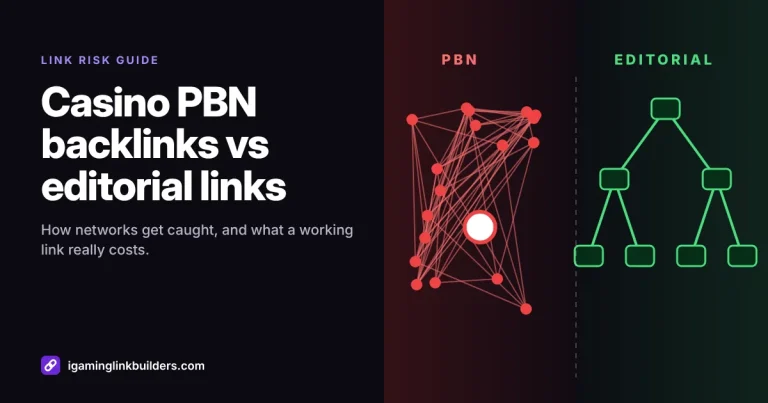
Shared templates, ownership, analytics IDs, author profiles, outbound customers and traffic patterns can reveal a network. A network link may look independent in a spreadsheet while concentrating operational and search risk in one supplier.
Bulk niche edits
An edit can be editorially valid when it corrects or improves a maintained resource. A service that inserts commercial links across old articles on demand is a different proposition. Inspect the page history, reason for the edit and publisher’s broader outbound pattern.
Site reputation abuse
Google’s site reputation policy covers third-party content published mainly to exploit a host site’s established ranking signals. Renting a folder or subdomain on a strong publisher for iGaming pages is not a durable alternative to earning editorial coverage. See Google’s site reputation policy.
Expired domains and redirected link equity
Do not buy an expired domain only to redirect inherited links into unrelated casino or affiliate pages. Google defines repurposing an expired domain primarily to manipulate rankings through low-value content as expired domain abuse. If a domain is acquired for a genuine business reason, preserve user expectations, relevant content and transparent ownership.
Forum and comment links
Use communities to answer questions and learn. Do not automate comments or place optimised signatures. Google explicitly identifies keyword-rich forum links as link spam.
How to respond to suspicious backlinks or a manual action
Do not disavow a domain merely because a tool labels it “toxic.” Google says most sites do not need the disavow tool and warns that incorrect use can harm search performance. It recommends disavowal only when there is a considerable number of spammy, artificial or low-quality links and those links caused, or are likely to cause, a manual action. See Google’s disavow guidance.
If Search Console reports an unnatural-links manual action:
- Export recent and top-linking data from Search Console and combine it with vendor records.
- Identify links your company or suppliers created that breach the policy.
- Request removal or qualification from the publisher.
- Keep a record of the URL, contact attempt and outcome.
- Use disavowal cautiously for links you cannot remove.
- Submit a reconsideration request that explains the cause, fixes and controls added.
Google says a manual action can affect part or all of a site and provides the issue and affected patterns in Search Console. See the Manual actions report documentation.
Frequently asked questions
What is iGaming link building?
iGaming link building is the process of earning or arranging relevant links to an online casino, sportsbook, poker, bingo, lottery, affiliate or industry-service website. A responsible programme combines useful content, publisher relationships, search-policy controls, market compliance and measurement.
Are backlinks still important in 2026?
Yes, but “important” does not mean every link helps. Google says it uses links to discover pages and as a signal when determining page relevance. Its spam policies cover links created mainly to manipulate rankings. Relevance, editorial reason, audience value and policy status matter more than a raw total.
How many backlinks does an iGaming site need to rank?
There is no defensible universal number. Compare the specific query, market, current page, referring-domain gap, content quality and technical condition. Set a target for qualified opportunities and business outcomes, not a promise that a fixed link count will produce a position.
How long does iGaming link building take to work?
No fixed timeline is reliable. A link must be published, discovered and assessed, and the target page still has to satisfy the query. Use 30-, 90- and 180-day reviews for operations, then judge the programme against target-page search and commercial results. Treat a guaranteed date as a sales claim, not evidence.
How much does iGaming link building cost?
Cost depends on the markets, languages, asset, expert access, publisher set, compliance work and whether exposure is earned or sponsored. Budget the full programme and compare cost per retained qualified referring domain, not a price per nominal link.
Is buying backlinks illegal?
There is no single worldwide answer. The contract, disclosure, gambling-ad rules, consumer law and target market all matter, so obtain market-specific legal advice. Separately, Google permits paid advertising and sponsorship links when properly qualified, but buying links to pass ranking credit violates its spam policy.
Should an iGaming site use only gambling websites for links?
No. The source should have a credible editorial reason and relevant audience. Depending on the asset, that could include sports, payments, cybersecurity, regulation, public companies, local business, data or technology publications. A loosely related site is not automatically valuable; document the audience connection.
Are nofollow or sponsored links useless?
No. They can send relevant referral traffic, disclose the commercial relationship and support brand discovery. Do not judge a partnership only by whether a link passes ranking credit.
What is the safest anchor-text ratio?
There is no universal safe ratio. Allow natural, descriptive citations and avoid forced exact-match commercial anchors. Review patterns for evidence of vendor or campaign manipulation instead of trying to hit a template percentage.
Can you use AI to scale linkable content?
Use automation for research support, classification, formatting and quality control, but retain expert review, original evidence and accountability. Google says mass-producing unoriginal pages mainly to manipulate rankings is scaled content abuse, regardless of how the content is created. Its people-first guidance also asks whether content adds original reporting or analysis and makes authorship clear. See Google’s people-first content guidance.
Final checklist
Before approving a link, confirm that:
- the target market and publisher audience are permitted;
- the page gives the reader a real reason to cite or click;
- the publisher passed legal, policy and editorial checks;
- any commercial relationship is disclosed;
- paid or sponsored links are qualified correctly;
- the anchor reads naturally and was not forced for rankings;
- the destination is accurate, stable, crawlable and useful;
- the live copy matches the approved claims and promotion terms;
- the link is recorded with owner, cost, date and review status;
- success will be judged by search, referral, commercial and risk metrics.
Conclusion
The strongest iGaming link building strategies in 2026 do not begin with a link quota. They begin with a market, a useful source and a publisher whose audience has a reason to care.
Build evidence worth citing. Give experts a clear route into relevant coverage. Use partnerships that make sense to users. Qualify paid links. Keep compliance inside the workflow. Measure retained, relevant referring domains and the business value they create.
That approach is slower to fake and easier to defend. It is also a better use of your brand, compliance and SEO budget.
Put these strategies to work
iGaming Link Builders runs campaigns like this for operators and affiliates every month. If you would rather hand the outreach to a team that only works in gambling, see our iGaming link building services. For casino money pages, start with casino link building; for faster movement on pages that already rank, use gambling niche edits.