When to Place Sports Betting Niche Edits: A Calendar Guide
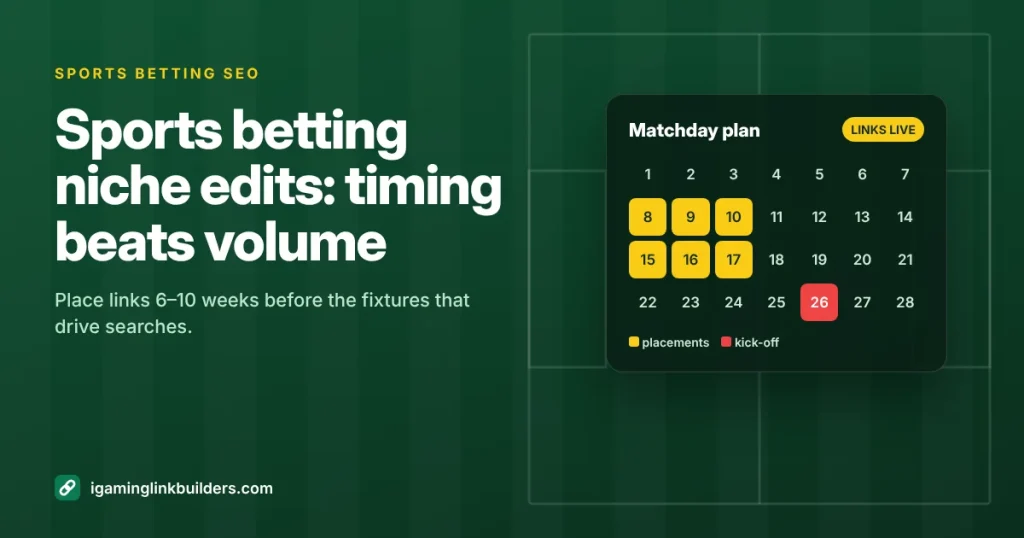
Sports betting niche edits work on a clock that casino links do not. Search demand for betting terms rises and falls with fixtures, so a link that goes live a week before a tournament has missed most of its window. This guide is about timing, host page selection and choosing the right target page, whether you run a sportsbook or a betting affiliate. For the service itself, see our gambling niche edits page.
Why betting niche edits need a calendar
A link does not help on the day it is placed. It has to be built, crawled, indexed and counted, and the target page has to climb past competitors who planned earlier.
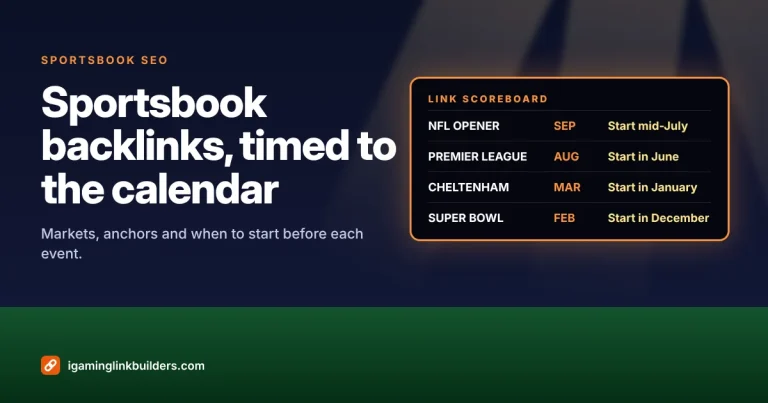
Our own timeline is 10 to 14 days from approval to a live link, plus a shortlist step of two working days before that. Add time for Google to recrawl the host page. In practice, the useful planning window starts six to ten weeks before the event that drives searches.
Key dates for the 2026/27 season
These are the dates that shape betting search demand for UK and US targets this season.
| Event | Dates | Plan links by |
|---|---|---|
| Premier League 2026/27 | 22 August 2026 to 30 May 2027 | Already running; target the run-in from March |
| NFL regular season | 9 September 2026 to 10 January 2027 | Playoff and futures pages by early December |
| Super Bowl LXI | 14 February 2027 | Mid-December to early January |
| Cheltenham Festival | Mid-March 2027 (confirm on the official site) | Mid-January to early February |
Sources: the Premier League for its season dates and the 2026 NFL season page for NFL dates. Check official schedules before you lock a plan.
Build on evergreen pages, harvest on event pages
Event pages such as “Super Bowl LXI betting odds” have a short life. Point the bulk of your links at evergreen hubs that carry authority year to year, such as an NFL betting hub or a horse racing betting guide.
Then use internal links from those hubs to the event page each season. The external links keep working after the final whistle; the event page borrows that strength for a few weeks.
Choosing host pages: odds, tipster and guide content
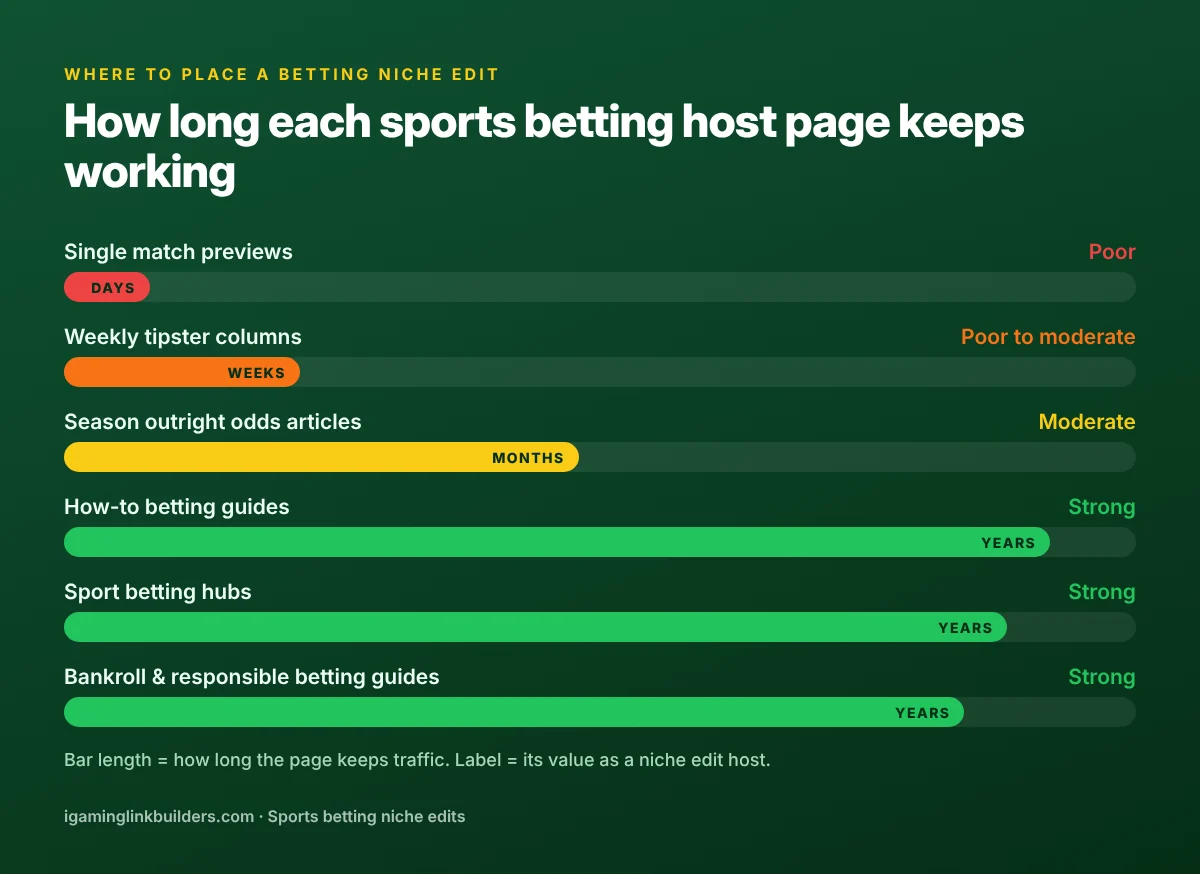
Sports betting sites publish several page types, and they are not equally useful as niche edit hosts. The key question is whether the host article will still be indexed and read in three months.
| Host page type | Lifespan | Niche edit value |
|---|---|---|
| Single match preview or tips | Days | Poor; traffic dies after kick-off |
| Weekly tipster column | Weeks | Poor to moderate; buried by newer posts |
| Season outright odds article | Months | Moderate; good for futures targets |
| How-to guides (each-way bets, asian handicaps) | Years | Strong; steady traffic, editorial tone |
| Sport-specific betting hubs | Years | Strong; often well linked internally |
| Bankroll and responsible betting guides | Years | Strong for brand anchors and trust pages |
What to check on a tipster site
Tipster sites can be excellent hosts or link farms dressed as tips. Before approving one, look at the following.
- Do tips carry dates, odds at time of writing and results? Real tipsters show their record.
- Is there a named author with a history on the site, or a rotating cast of “guest experts”?
- How many sportsbook links sit in each article? One or two recommended books is normal. Ten affiliate links in a 400-word preview is not.
- Does the site rank for its own tip queries, or only receive traffic from social channels?
- Is the traffic in the markets where your book or your affiliate partners are licensed?
Compliance on the host page matters to you
If a UK host page breaks advertising rules, your link sits on content regulators may act on. Since 1 October 2022, CAP rules bar gambling ads with “strong appeal” to under-18s, and ASA guidance treats football betting ads as being of “inherently strong appeal to under 18s” unless steps limit that appeal, as Osborne Clarke summarises. Skip hosts that lean on youth culture, current star players or promises of easy wins.
Sportsbook targets vs affiliate targets
The right target page depends on who you are. Sportsbooks and affiliates rank different page types and carry different risks.
| Factor | Sportsbook (operator) | Betting affiliate |
|---|---|---|
| Main ranking pages | Brand terms, sport landing pages, promotions | Bookmaker reviews, best betting sites lists, free bets |
| Best niche edit target | Sport hubs and app pages | Comparison pages and evergreen guides |
| Anchor approach | Brand and URL anchors almost always | Mostly branded; partial-match on strongest hosts |
| Host sites to avoid | Sites that also push unlicensed books | Direct competitors who may remove links later |
| Market constraint | Only where licensed | Only where partner books are licensed |
Sportsbook targets
Operators usually have plenty of brand links but weak non-brand pages. A sportsbook’s “football betting” or “horse racing betting” hub is often the best target. These pages compete with affiliates for generic terms and rarely get links on their own.
Keep anchors branded. Exact-match anchors pointing at an operator’s promo page are one of the clearest paid-link footprints.
Affiliate targets
Affiliates live on comparison and review pages. These pages change often as partner deals change, so pick targets with stable URLs.
Spread links across the hub and its supporting guides rather than piling them on a single “best betting sites” list. Our affiliate link building plans follow that model.
An illustrative plan for one affiliate
The plan below is an illustrative example, not a client result. It shows how timing, host selection and targets fit together.
A UK betting affiliate wants to grow its horse racing section before Cheltenham 2027. It has a racing betting hub, an each-way betting guide and a Cheltenham betting page that it updates every year.
- Early January: approve a shortlist of racing and general sports betting publishers with UK traffic.
- Mid-January: place four edits on evergreen racing guides, pointing at the racing hub with branded anchors.
- Late January: place two edits on “how to bet each-way” articles, pointing at the each-way guide.
- February: strengthen internal links from the hub and the each-way guide to the Cheltenham page.
- After the festival: keep the hub links and refresh the Cheltenham page for next year.
No external links point directly at the event page. It gains strength through the internal links, and the outside links keep supporting the hub year round.
Mistakes we see in betting link campaigns
- Buying links two weeks before a major event and expecting rankings before it starts.
- Using match previews as hosts because they are cheap and look relevant.
- Pointing every link at a homepage or a single “free bets” page.
- Accepting hosts whose traffic comes from countries where the book is not licensed.
- Copying an operator’s anchor pattern on an affiliate site, or the other way round.
- Ignoring Google’s note in its spam policies that “buying or selling links for ranking purposes” is link spam unless the links are qualified. Pace and variety matter.
How we handle sports betting niche edits
Our sports betting link building campaigns start with your calendar. We map the events that matter to your markets, then work back from them.
Every publisher passes our 9-point check, including traffic in your markets and confirmed indexation after placement. Shortlists arrive within two working days, nothing is pitched until you approve, and links go live 10 to 14 days later. Prices are $350 per link for DR 30+ gambling publishers and $500 for DR 50+, and every link carries a 12-month replacement guarantee. The same process covers casino and poker placements through our niche edits for gambling sites, and our iGaming SEO guide shows how links fit a wider plan.
FAQ
How early should I place niche edits before a major event?
Aim for six to ten weeks before search demand peaks. That allows for shortlisting, placement, indexing and the ranking climb. Pointing links at an evergreen hub rather than the event page makes timing less critical.
Are tipster sites good hosts for sports betting niche edits?
Some are. Look for dated tips with results, named authors and few sportsbook links per article. Avoid single-match previews, which lose traffic after the game.
Should sportsbooks use exact-match anchors?
Rarely. Operator sites carry the most scrutiny, so branded and URL anchors should make up most of the profile. Partial-match anchors can work on the strongest topical hosts.
Can one campaign cover several sports?
Yes, if each sport has its own hub and its own host pages. Mixing a racing host with a football target weakens relevance on both.
As a specialist iGaming link building agency, we only build links in the gambling industry. If you want links in place before the next big betting window, send us your markets and target pages. We will map your calendar and return a shortlist for approval within two working days through our sports betting links service, or you can contact us directly.